Poppy Crocus Rose Floral Repeat Patterns for Creative Projects
Floral patterns have a timeless appeal, whether you are designing fabric, building a brand identity, or crafting custom stationery. The challenge often lies in finding patterns that feel both artful and versatile enough to work across different mediums. The Poppy Crocus Rose Floral Repeat Patterns collection offers exactly that: a set of five botanical seamless patterns designed to integrate smoothly into professional and personal projects. This article explores what makes these patterns useful, who can benefit from them, and how they support practical outcomes like saving time, maintaining visual consistency, and simplifying the design process.
What Makes These Floral Seamless Patterns Distinct
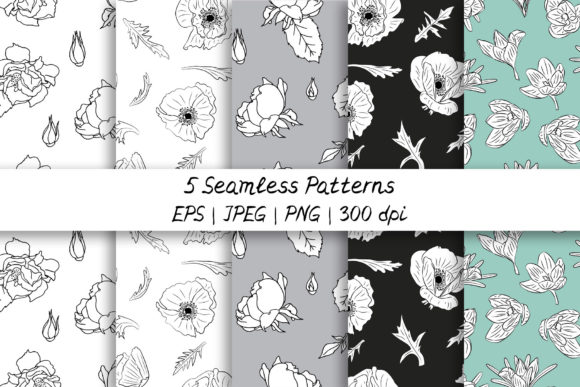
At its core, this collection brings together roses, poppies, crocuses, leaves, and buds into repeating motifs that can be used across countless applications. Each pattern is built as a seamless tile, meaning it repeats without visible edges or interruptions. This technical detail matters more than it may seem at first glance. When you are working on textile design, wrapping paper, or digital backgrounds, a pattern that tiles cleanly eliminates the need for manual adjustments or patching work. You can fill large areas confidently, knowing the repeat will hold together consistently.
The set includes five distinct pattern variations. While the specific motifs rotate around floral and botanical imagery, each pattern carries its own visual rhythm. Some may emphasize larger blooms with scattered buds, while others lean into denser arrangements of leaves and petals. This variety gives you room to choose the right mood for each project, whether you need something airy and delicate or rich and layered.
Technical Details That Support Real Design Workflows
The collection supplies files in three formats: EPS10 fully editable vector files, PNG files with transparent backgrounds at 5000x5000 pixels and 300 dpi, and JPEG files at the same resolution with white, black, gray, and turquoise backgrounds. Each format serves a different stage of the design process, and having access to all three reduces friction when moving between software or preparing files for production.
Vector files, particularly EPS10, allow you to open each pattern in applications like Adobe Illustrator, scale it to any size without losing quality, and edit individual elements. This is especially valuable for professionals who need to adjust colors, resize motifs, or combine elements from different patterns. You are not locked into a static image. Instead, you have the freedom to treat the pattern as a raw material that can be adapted to fit your exact specifications.
The PNG files with transparent backgrounds are ready for layering. If you are designing a sticker sheet, a digital scrapbook element, or a branding asset, you can place the pattern over other graphics or photographs without worrying about background clashes. The high resolution and 300 dpi standard ensure that even large prints retain sharpness and detail, which is critical for textile printing, packaging mockups, and presentation materials.
The JPEG variants with multiple background colors add another layer of convenience. Rather than manually adding a solid background to the pattern, you can choose from white, black, gray, or turquoise depending on the context. This saves time during early prototyping or when you need to show a client how the pattern behaves against different surfaces.
Textile Design: Consistency Across Fabric Runs
Textile design demands precision. A pattern that repeats cleanly is not optional; it is a basic requirement for fabric printing, embroidery, and weaving. Seamless patterns from the Poppy Crocus Rose collection allow you to test motifs on digital garment mockups or actual fabric samples without worrying about alignment issues. Because the vector files are fully editable, you can also adjust scale to suit different fabric types. A large repeat might work beautifully on a duvet cover, while a smaller repeat suits a scarf or accessory.
If you are a textile designer or a small apparel brand, having five different patterns in one set means you can offer variety without commissioning custom artwork for each design. You can mix and match patterns across a collection, creating visual cohesion while keeping production practical.
Stationery and Paper Goods: Ready for Print-Ready Output
Paper stationery products like notebooks, greeting cards, wrapping paper, and planners benefit greatly from patterns that tile seamlessly. The high-resolution JPEG and PNG files can be dropped directly into print templates. Whether you are printing at home or using a commercial print service, the 300 dpi resolution ensures clean, professional results.
For small business owners who sell on platforms like Etsy or at craft markets, time is often limited. A pattern set that comes pre-optimized for print saves hours of layout work. You can focus on designing the product itself rather than building repeats from scratch.
Branding and Packaging: Maintaining Visual Identity
Branding often extends beyond logos and typography. Patterns can be used as background textures on packaging, tissue paper, shopping bags, or website banners. The EPS10 files let you adjust colors to match a brand's palette exactly. If your brand uses a specific shade of green or a muted blush tone, you can edit the pattern vectors accordingly without starting over.
Packaging designers also appreciate the availability of four background colors in the JPEG set. Turquoise, in particular, can offer a fresh, contemporary feel that works well for lifestyle or botanical brands. The ability to see how the pattern interacts with different backgrounds during the concept phase helps speed up decision-making.
Sticker and Merchandise Creation: Versatile Assets for Multiple Products
Stickers are a popular product category for creators, and transparent-background PNG files are essential for this use case. You can layer the floral patterns onto die-cut shapes, combine them with typography, or use them as fill patterns inside custom illustrations. Because the files are high-resolution, stickers printed at various sizes remain crisp.
Beyond stickers, these patterns can be applied to phone cases, mugs, tote bags, and other merchandise. The vector format ensures that scaling up for large items does not introduce pixelation. This flexibility supports creators who sell across multiple product categories and need assets that perform consistently regardless of the medium.
Who Benefits Most From This Collection
The patterns in this set are broadly useful, but certain groups will likely find them especially valuable.
- Freelance graphic designers and illustrators who take on diverse projects benefit from having a versatile asset library. These patterns can serve as starting points for custom commissions, saving time on initial layout while still allowing creative input.
- Small business owners in the gift, stationery, or apparel space often operate without a dedicated design department. Having ready-made, high-quality patterns reduces reliance on expensive custom work and speeds up product development cycles.
- Hobbyists and DIY creators who design for personal use, such as wedding invitations, party decorations, or home decor, will find the file formats accessible. The PNG files can be used in simple software like Canva or Procreate, while advanced users can open the EPS files in professional tools.
- Teachers and educators creating classroom materials or bulletin boards may also appreciate the botanical theme for nature-related lessons, art projects, or decorative displays.
That said, the collection may not suit every aesthetic. If your brand or project leans toward minimalist, geometric, or abstract styles, floral repeat patterns may feel mismatched. Similarly, users who need extremely large tile sizes beyond what a 5000x5000 pixel file provides may need to scale the vector files and test the repeat behavior at their target dimensions. As with any asset, it is wise to preview the patterns in your actual project context before committing to a final design.
Practical Recommendations for Using These Patterns Effectively
To get the most out of the Poppy Crocus Rose Floral Repeat Patterns, consider how you plan to use each file format across your workflow.
Start with the EPS10 vector files if you need to customize colors or scale before exporting. Most vector software lets you preview the pattern repeat, so you can check that the tile works as expected at your intended output size. If you are designing for print, keep the original 300 dpi resolution in mind throughout your layout process.
The PNG files with transparent backgrounds are ideal for digital mockups and on-screen presentations. Use them to test pattern placement on product templates before committing to a final version. The transparent edges also make them easy to layer into composite images or use as overlays.
When you need a solid background, the JPEG files with white, black, gray, and turquoise backgrounds offer quick options for product photography, social media graphics, or packaging prototypes. You can also treat these as reference files to see how the pattern reads against different backgrounds before deciding on your final production color.
If you are working with other designers or vendors, sharing the EPS10 files ensures that anyone with vector software can edit the patterns without losing quality. This is particularly helpful when collaborating with print shops that may need to adjust file specifications for their equipment.
Thoughtful Observations on Floral Patterns in Modern Design
Floral motifs have been a staple of design for centuries, but their role in contemporary digital and print work continues to evolve. Today, designers often balance a desire for organic, natural imagery with the need for efficiency and scalability. Seamless pattern collections offer a practical bridge between these priorities. They bring the warmth and detail of hand-drawn botanical elements into a format that meets the technical demands of modern production.
What makes this particular collection noteworthy is its combination of rose, poppy, crocus, leaf, and bud motifs. Each flower carries its own visual character. Roses suggest romance and structure. Poppies introduce movement and bold color potential. Crocuses offer a quieter, early-spring delicacy. Together, they create patterns that feel layered and intentional rather than repetitive in a monotonous way.
For creators who value both artistry and practicality, having five patterns in one set provides a small library of design options without the overhead of managing dozens of separate files. It supports a focused, efficient creative process while still delivering visual richness.
Final Considerations Before You Start Designing
Before using any pattern asset in a commercial project, it is wise to review the license terms that apply to your specific purchase. While the file formats and resolution are clearly defined, usage rights can vary. If you plan to resell items featuring these patterns, confirm that your license covers commercial use. This step protects your work and ensures you can confidently scale your products.
Also consider testing each of the five patterns in a small sample before full production. Even seamless patterns can behave differently depending on the material, scale, and printing method. A quick test print or digital mockup can reveal whether a particular pattern works well at your target dimensions or if you need to adjust the repeat.
The Poppy Crocus Rose Floral Repeat Patterns collection offers a thoughtful combination of botanical beauty and technical utility. Whether you are designing fabric, building a brand, creating stationery, or crafting merchandise, these patterns provide a solid foundation that respects your time and creative freedom. With five patterns in editable vector and high-resolution raster formats, you have the flexibility to adapt, customize, and produce across a wide range of projects.